
Douglas County City Directory Collections
Omaha is the county's main historical directory center, but place labels matter. A volume may identify Omaha, South Omaha, Benson, Dundee, Florence, or another community separately. The Omaha Public Library directory collection is the strongest starting point for this work. Its published list gives Omaha print coverage from 1866 to the current period and Omaha microfilm coverage from 1866 through 2001. Record the format used because a print volume, microfilm reel, and digitized scan can expose different viewing or copying choices.
| Collection | Years | Where Held | Access |
|---|---|---|---|
| Omaha print directories | 1866-current | Omaha Public Library collection | Collection access, subject to current library service |
| Omaha microfilm directories | 1866-2001 | Omaha Public Library microfilm collection | In-library reader access |
| Collins' Omaha volume | 1866 | Google Books | Digitized title and searchable text |
| McAvoy's Omaha volume | 1898 | Google Books | Digitized title and searchable text |
The same OPL list also identifies separate runs for Bellevue/Sarpy County, Council Bluffs, Fremont, Lincoln, and Nebraska City. Bellevue/Sarpy coverage is listed for 1963-1989, 1991-2007, and 2009-current. Those are distinct runs, not proof that an Omaha listing covers every Douglas County address. Check the year, title, and place label before carrying a result across a boundary.
The OPL collection page is shown in this captured reference view.
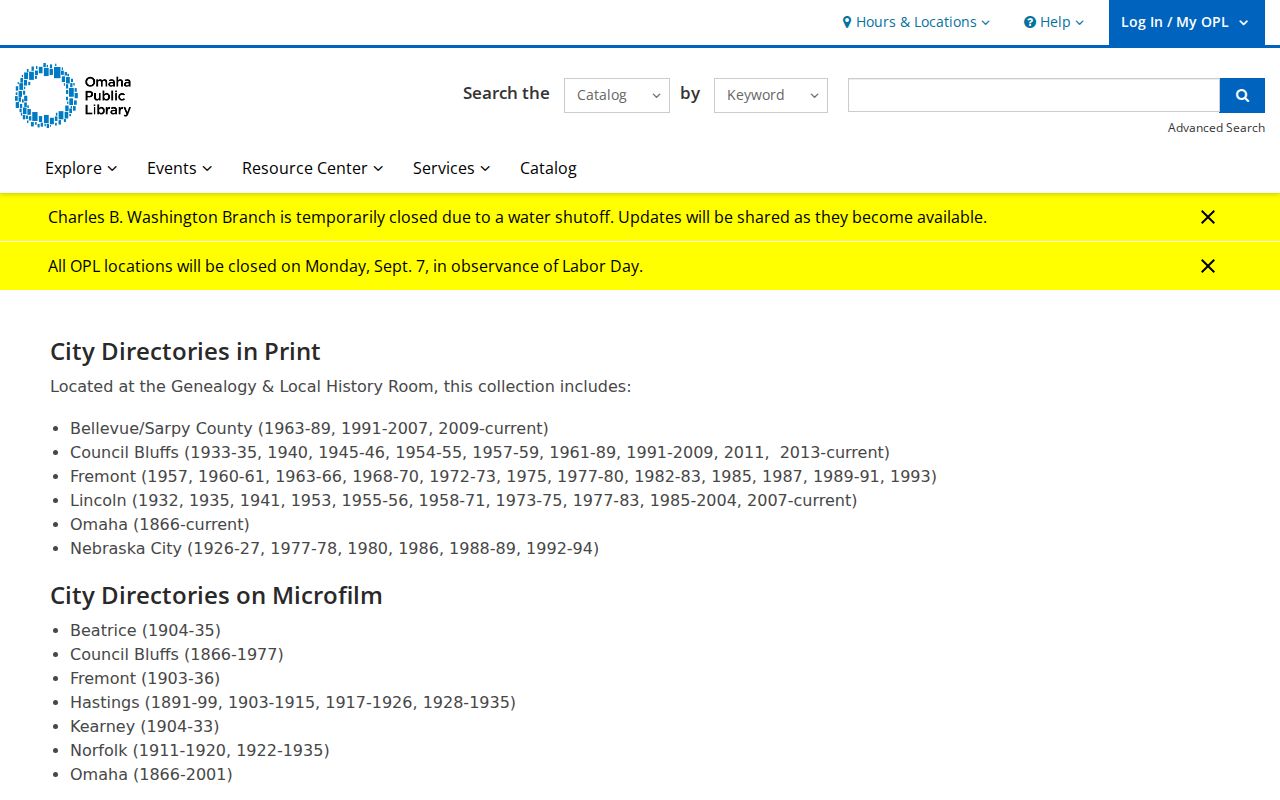
The collection page is the useful run list before requesting a particular year, rather than a promise that every volume can be searched in one form.
Douglas County City Directories Begin in 1866
The 1866 Collins volume is an especially early local reference point. Nebraska Territory was organized in 1854, its first territorial legislature met in Omaha in 1855, and Nebraska became a state in 1867. That timing makes the directory a dated view of Omaha shortly before statehood, not a modern profile of its residents. Its contents include a general index, Omaha material, churches, Masonic organizations, and city, county, and federal officers.
Collins uses abbreviations including res and bds, and its organization is built for name and address reference. The digitized Collins title identifies the publisher and permits a dated check of the volume. A listing should still be cited by its own page image. The research did not capture a page-by-page sample entry, so details such as a spouse, ownership marker, or household arrangement should never be assumed from the title alone.
Note: An early directory is a publication statement for its year, not proof of ownership, family relationship, or a present address.
Reading a Douglas County City Directory Entry
Read a city-directory entry as a compact, dated record. The Collins and McAvoy samples support name, address or residence wording, occupation, and period abbreviations. A person may appear at a business address, a boarding location, an institution, or a home. The right conclusion is usually "listed at" rather than "lived at" until another dated source agrees. Photograph or note the title page and abbreviation key with the entry because conventions can change between publishers and years.
| Name | Use the spelling, initials, and order printed in that volume. |
|---|---|
| Residence or address | Capture the street wording exactly, then compare normalized and historical forms. |
| Occupation or business | Record it as printed, without treating it as a current fact. |
| res or bds | Period abbreviations found in Collins that help explain residence or boarding wording. |
| Household or ownership notation | Check the specific volume. These details were not verified as a universal field in the local runs. |
- Criss-cross directory
- An address-order section, when a particular volume includes one, used to approach listings from the street rather than the name.
- Householder index
- An index organized under a household head when the publication uses that arrangement.
- Abbreviation key
- The volume's own explanation of shortened terms. Read it before expanding a mark in an entry.
Douglas County Digitized Volumes
Digitized samples are useful when a researcher needs to test a spelling, learn a period convention, or confirm that a title exists before asking for a library copy. The 1898 McAvoy's Omaha title identifies Omaha Print. Company as publisher. Searchable text includes addresses, residence abbreviations, and occupations. The research does not establish a complete list of later publishers or every title change, so those details belong to the relevant title page and catalog record.
The captured McAvoy's 1898 directory listing shows the digitized source used for this dated sample.
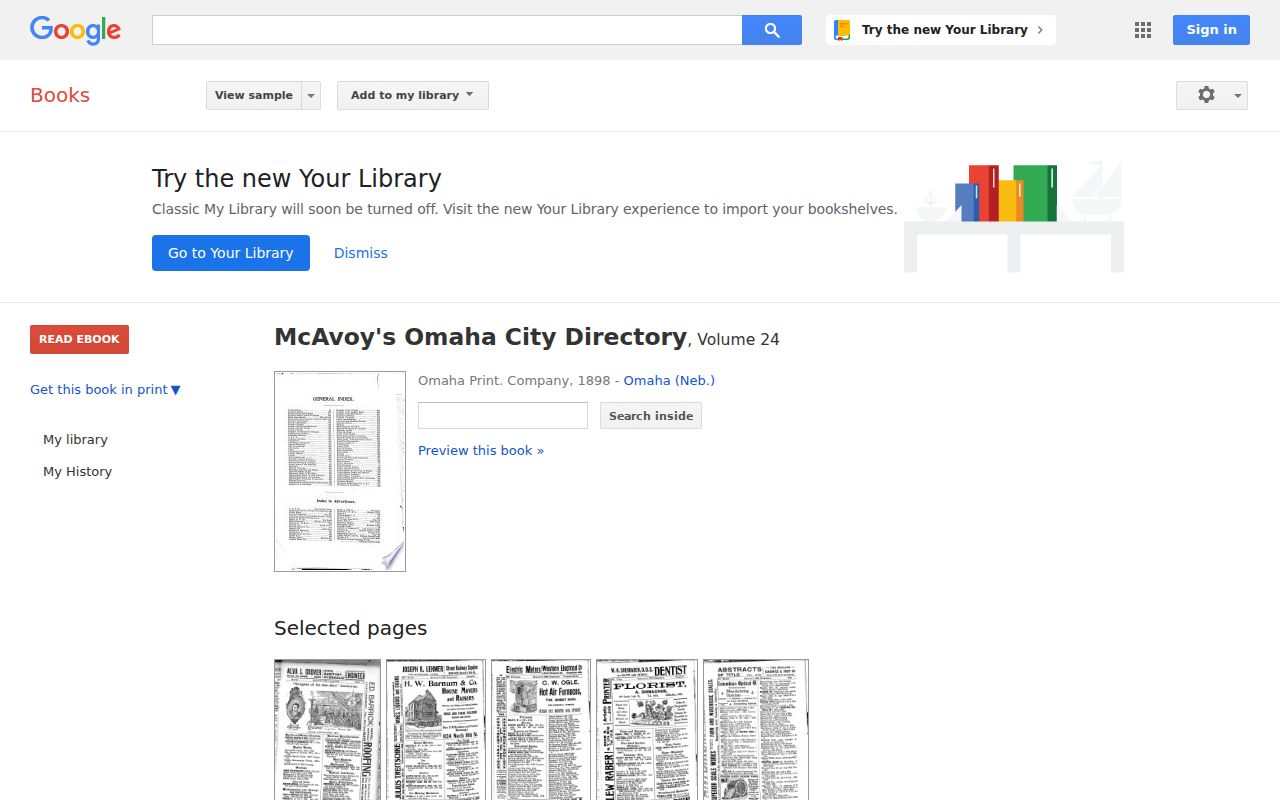
Use the scan to locate an entry, then retain the volume year and page rather than relying only on a search-text fragment.
Douglas County Research at OPL
The OPL genealogy and local-history service brings directories together with Nebraska reference works, maps, newspapers, cemetery information, yearbooks, funeral pamphlets, government documents, and more than 7,000 microfilm or microfiche materials. Its listed resources make good cross-checks for a name or address that changes from one directory year to the next. Ancestry Library Edition is listed for in-library use, so access conditions should be checked before a visit.
The microfilm room has four readers that scan to USB and two that print up to 11.5 by 17 inches. That offers a practical route when an entry is not digitized. For a focused remote question, OPL research help can check in-house obituary indexes, the 1866-current directory collection, and book indexes for up to three names. Requests may be sent by mail, email, or the library form. The published advance prices are $5 for a simple copy request and $20 for up to a half hour of more extensive research, including five copies.
This microfilm-room capture illustrates the in-library access channel for a Douglas County directory search.
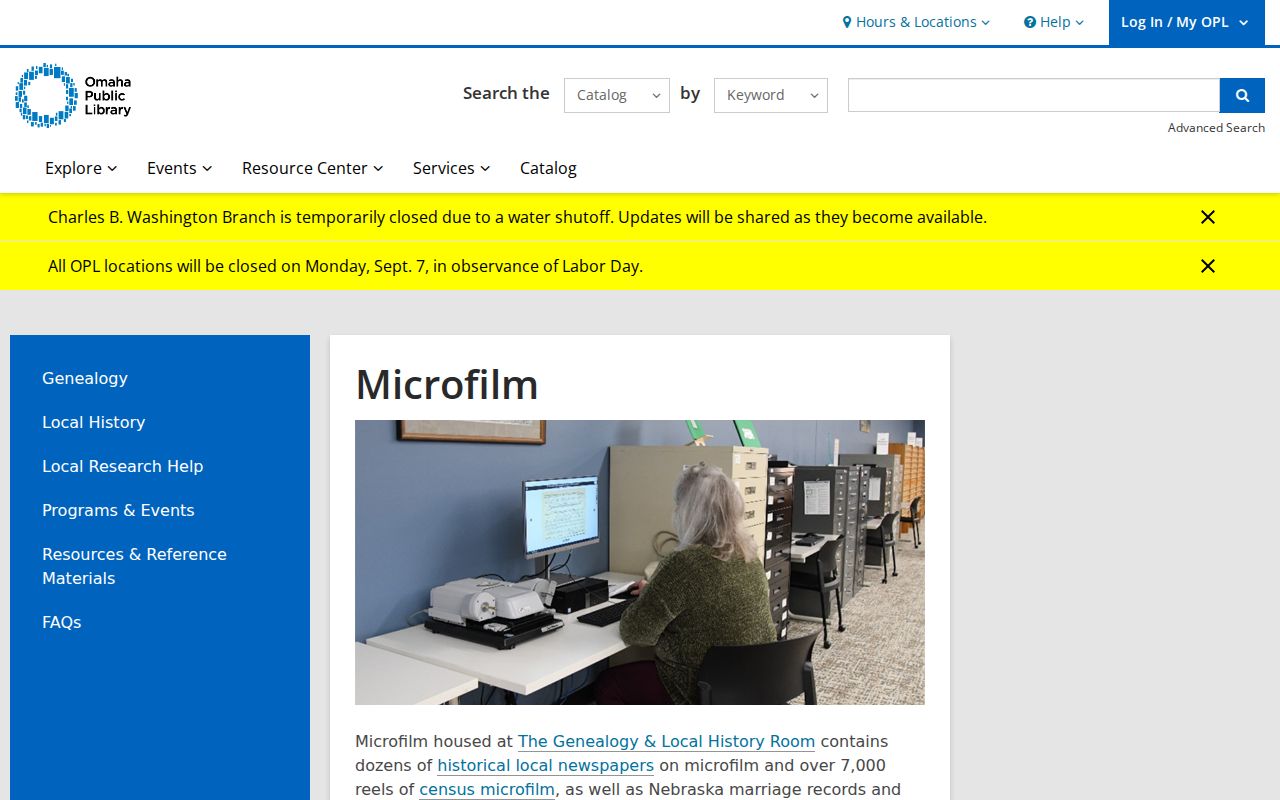
When asking staff for help, provide name variants, an approximate date, a city or neighborhood, an address, the record type, and whether a scan or citation is needed.
Place Names in Douglas County City Directories
Directories should preserve the place name used by the source. Omaha, South Omaha, Benson, Dundee, Florence, Elkhorn, Bennington, Valley, and Waterloo are not interchangeable labels. A postal city name, current neighborhood, municipal boundary, and historical directory heading can point to different geography. The City of Omaha's GIS tools and maps can help compare current city limits, neighborhood associations, historic properties, and related layers, but it is a current geography tool rather than a historical directory.
For archival material beyond the library shelf, the Douglas County Historical Society accepts advance research requests for noncirculating, staff-supervised material. Its policy states a ten-day lead time, staff research at $20 per hour with a one-hour minimum, copies at $0.25 per page, and scans at $1.50 per page. Its main site reports that in-person archive requests are temporarily suspended, so confirm present service before planning a visit.
Trace Douglas County City Directories for Family History
A household trail starts with the earliest confirmed directory listing and moves one year at a time. Keep the person's exact spelling, address, printed role, and page. Then compare nearby years instead of treating a disappearance as a final answer. A name can move, be indexed differently, appear at a business, or be absent from a particular volume. The household layer and the land-record layer answer different questions, so do not turn a directory address into proof of title.
- Find the first confirmed name or address in an OPL directory and record the title, year, page, and format.
- Check the year before and after it for spelling variants, address changes, and the publication's own abbreviations.
- Use an address-order or criss-cross section only when that volume contains one, then compare nearby listings without assuming a relationship.
- Pair the directory years with the matching census period, newspapers, cemetery material, church records, or yearbooks available through OPL.
- Resolve a conflict with the source that best fits the question, such as a deed image for an instrument or a directory page for a printed listing.
OPL's newspaper resources include the Omaha World-Herald digital archive for 1878-1983, Omaha Star material for 1938-2011, later newspaper access, and an obituary index route. Cemetery and church microfilm are institution-specific, but can add a date, witness, parent, sponsor, plot owner, or address. These are cross-checks, not automatic identity matches.
Note: A matching name and address need a second dated signal before they are carried across decades.
OPL Access in 2026
OPL reported a service transition in January and March 2026 as the older Genealogy & Local History Room at 84th and Frederick prepared to move. Staff continued answering research@omahalibrary.org. The March update described a third-floor genealogy area in the new Omaha Central Library, more work space, about 10,000 volumes on the floor, and twice the computers, with an April 19, 2026 opening planned at that time. The January notice and March update are useful context, but location and hours should be checked again before a visit.
Douglas County City Directory Evidence Test
Label the strength of every finding. A page image is a direct dated publication record. A library catalog or collection list is an index pointer. A historical-society or state archive inventory is a finding-aid pointer until the item itself is read. The Nebraska State Historical Society collections search reaches finding aids, digitized archives, collection records, and the library catalog, so the same keyword may need to be tried in more than one system.
For a current address question, use the Douglas County street directory for the address-keyed record path. For a historical directory hit, retain the repository, title, year, publisher, page or image, source URL, and the date access was checked. That small citation trail preserves the difference between a lead and a confirmed record.