
Douglas County Resident Lookup Coverage
No single Douglas County record establishes a complete identity. A parcel result can show the assessor's displayed owner or taxpayer information and a situs address. A court record identifies a party's role in a case. Voter and vital systems are governed by separate access rules. Use the record's own date and role rather than treating a name hit as proof of current residence, ownership, relationship, or activity.
| Record | What It Confirms | Where | Access |
|---|---|---|---|
| Parcel record | The assessor's displayed parcel, situs, legal-description, and owner or taxpayer fields. | Douglas County Assessor | Official starting point; live field coverage was not fully captured. |
| Voter registration | A matching registration record's address, party association, ballot status, and polling information. | Nebraska VoterView | Public lookup with statutory limits. |
| Court case | A party role, case number, case type, events, and available filed material. | Nebraska JUSTICE eServices | General lists are free; detail has a stated fee. |
| Vital-record order | Whether DHHS can issue the requested certificate under its purpose and relationship rules. | Nebraska DHHS Vital Records | Request-based and not a general-name directory. |
| License record | An agency's displayed credential type, status, and, when present, city or ZIP. | DHHS License Information System | Official search; compare a second identifier. |
Begin with the most specific fact already known. An address can lead to a parcel and then a legal description. A case number is stronger than a plain name in JUSTICE. A name plus county can be used in VoterView, while a vital-record request requires its own proof and purpose. The source should remain labeled as an assessor display, voter record, docket, certificate request, or license result.
Douglas County Resident Lookup in JUSTICE
Nebraska Judicial Branch eServices covers county and district courts statewide, including Douglas County's county, district, and separate juvenile-court structures. Its general search accepts party name, court type, case type or subtype, county, year, judge, and attorney. It also offers judgment-date and court-case-number searches. Use the Douglas County filter with a year or court type whenever that information is known. The system describes a 24-hour lag, so a very recent filing may not appear at once.
The Douglas County Court listing identifies the Hall of Justice and its county-court divisions. The resulting page is a useful jurisdiction check before a reader assigns meaning to a name match.
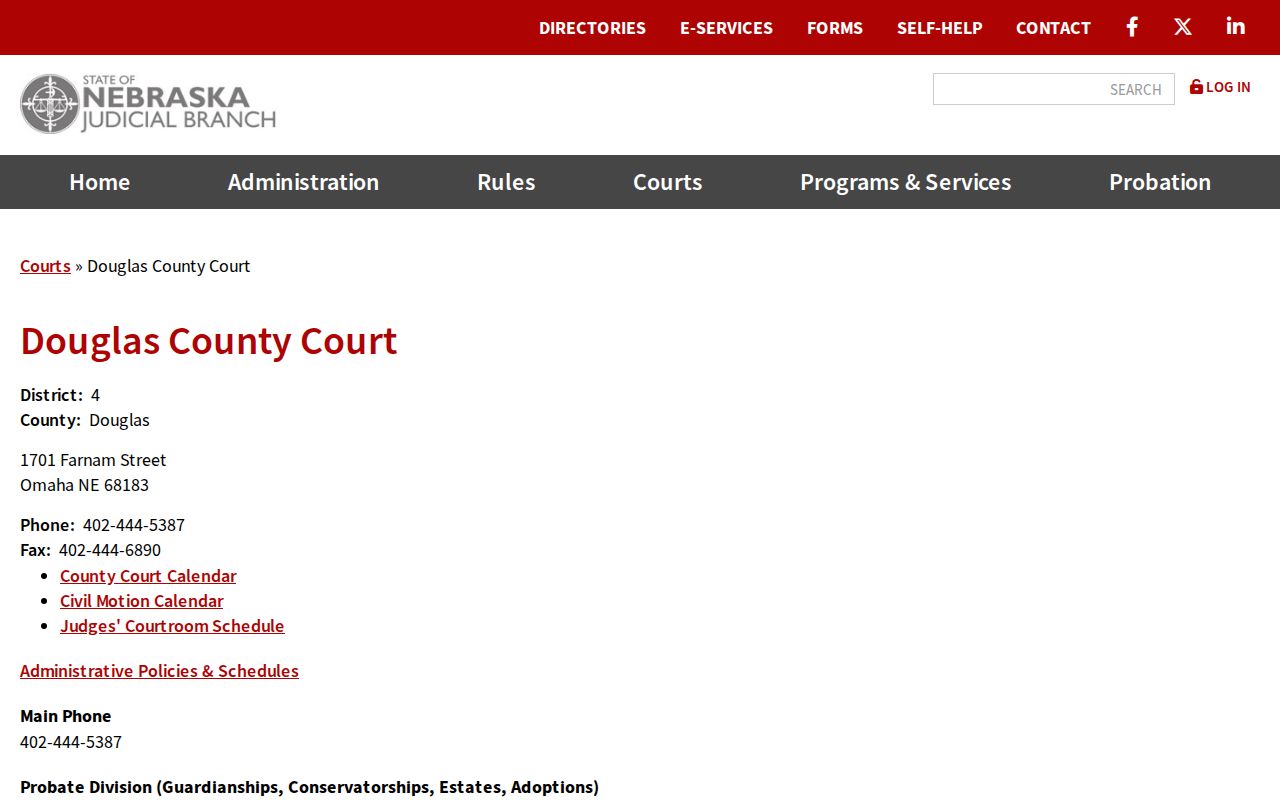
County Court handles listed probate, civil, traffic, misdemeanor, and small-claims matters within its jurisdiction. A case entry identifies a legal event, not a person's current address or a broad biography.
General case lists are free under the current eServices explanation, case detail is $2, and document images have no additional stated charge. The separate one-time name search requires a party name and permits extra court, county, and case filters. It costs $17, can return up to 30 public cases, charges even when no result is found, and remains available for three calendar days. Its stated image availability begins with documents filed after April 16, 2008. Check the portal's installation dates before reading an empty search as a final answer.
The official one-time JUSTICE name-search screen shows the party-search route described by the Judicial Branch.
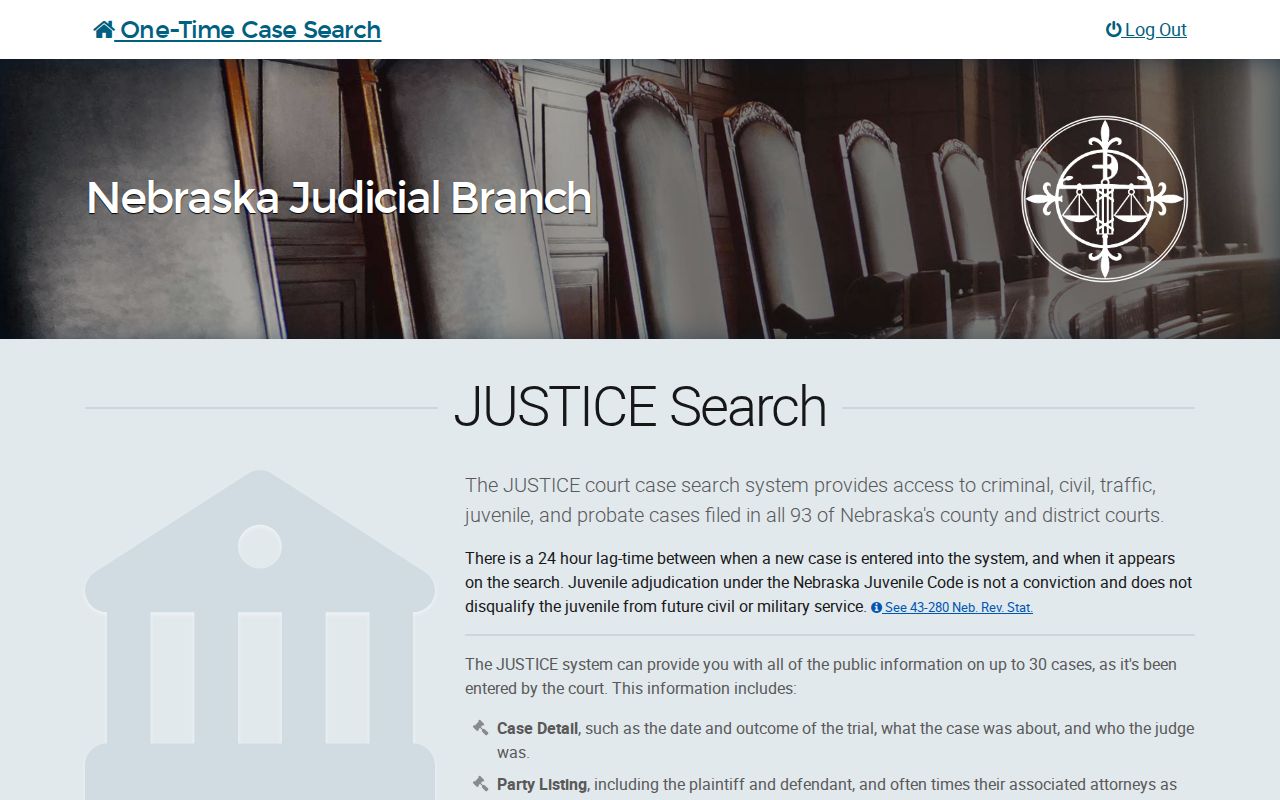
Keep the searched spelling, filters, case number, and retrieval date with any result. That makes a later verification possible without claiming more than the court record states.
Verify a Douglas County Resident
A careful resident lookup compares signals instead of matching names alone. Middle initials distinguish entries within a dated source, but they do not prove identity across decades. An address plus year can link a directory, permit, parcel, or map to a place, but it does not prove ownership or occupancy. Capture the record type and the source-specific role every time a result is used.
- Normalize the name exactly as it appears, then keep alternate spellings rather than replacing them.
- Use the Douglas County Assessor as the official parcel starting point when an address is known. Save the parcel or account number, situs address, and legal description if displayed.
- Run the name through JUSTICE with Douglas County and any known court, case type, or year. Compare party role and case number rather than just the name.
- Use VoterView only for its stated registration and polling information. For a certificate, follow DHHS purpose, relationship, identification, and release rules.
- Reconcile the dates and retain the custodian URL, record ID, or page reference. A conflict may reflect a different role, date, jurisdiction, or protected record.
For an older Omaha household, a dated entry in the Douglas County city directory collections can add a historical address signal. It remains a publication entry, not proof of title, relationship, or current status.
- Docket
- A court's case record, including parties, events, hearings, orders, and other case information that the public system makes available.
- Index vs. image
- An index points to a record through fields such as name, case number, book, or page. An image is the underlying filed document or scanned page when access is available.
- Certified copy
- A copy issued by the custodian with the certification required for the purpose stated in the request. It is not the same thing as an online index entry.
Douglas County Voter Lookup Limits
Nebraska VoterView has separate registration, polling-place, and pending-registration utilities. Registration Information asks for first name, last name, and county. Polling Place Search uses a residential address. Pending Registration uses the receipt number from the registration workflow. A matching registration result can show the address, party association, absentee or provisional ballot status, and polling location, while a no-match can reflect the search terms or the record's status.
The Douglas County Election Commission's voting-information form uses a house number and ZIP Code to return a polling place, candidates, sample ballot, elected officials, and political subdivisions. The commission's August 3, 2026 display reported 367,700 registered voters. That number is a dated administrative snapshot, not a count to attach to an individual record.
Neb. Rev. Stat. §32-330 permits public inspection of the voter-registration register at the election commissioner or county clerk office, but copying and distribution have purpose, oath, and use restrictions. A request identifies the requester and permitted purpose. Protected records and Address Confidentiality Program participants require suppression. A standalone Douglas County voter-file request form was not located in the official research, so use the commission's written or in-person channel rather than assuming an online bulk form exists.
Douglas County Vital Record Access
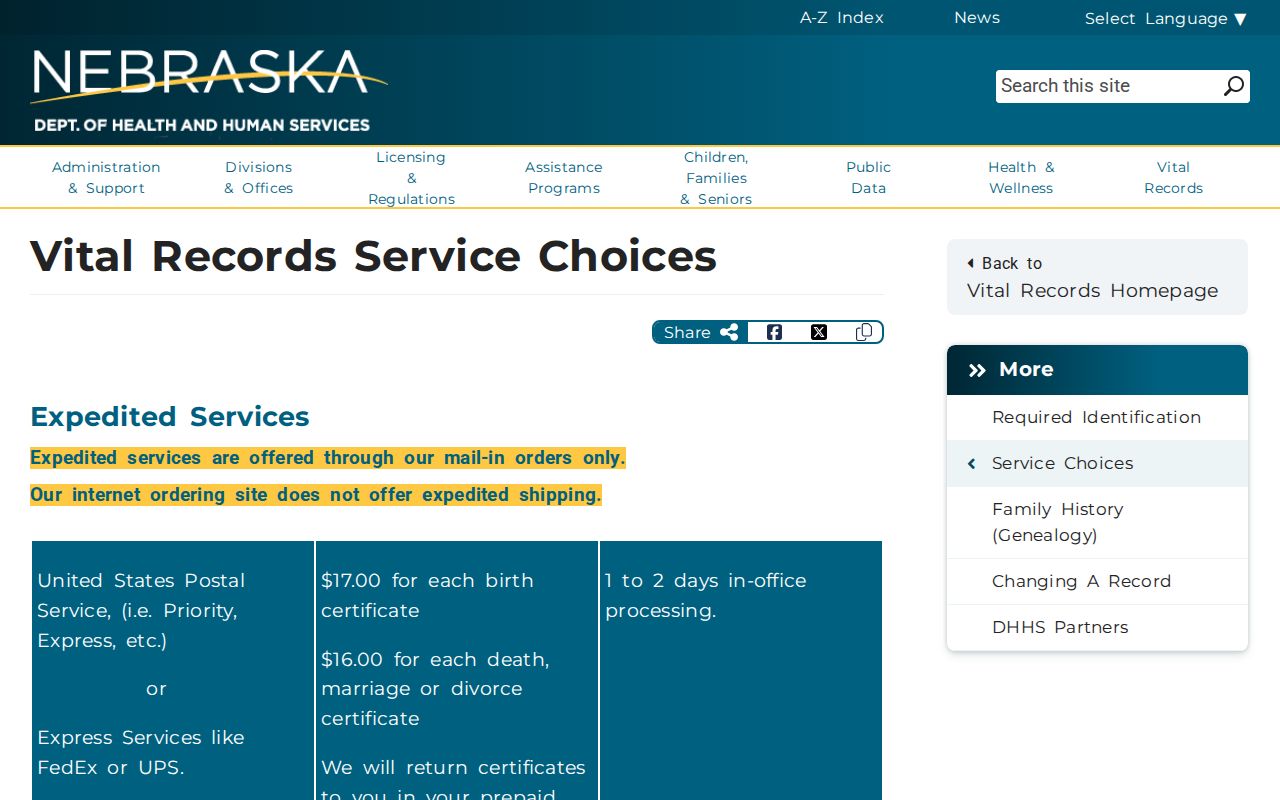
Nebraska DHHS keeps birth, death, marriage, and divorce records under rules that are different from an open resident lookup. Ordinary applications require proper purpose. Depending on the certificate, DHHS asks for identity and relationship information along with record details. Birth certificates are listed at $17, while death, marriage, and divorce certificates are listed at $16. The current service-options page describes walk-in, view-only, mail, and online routes.
DHHS service options describe the available order paths and processing conditions.
For a marriage request, the official form asks for names, county of license, marriage date, purpose, relationship where applicable, requester contact information, photo ID, and a selection between a long form and abstract. The form includes an older office address, so current mailing information should come from the DHHS web page instead.
The DHHS online order service is the official route for applicable certificate orders.
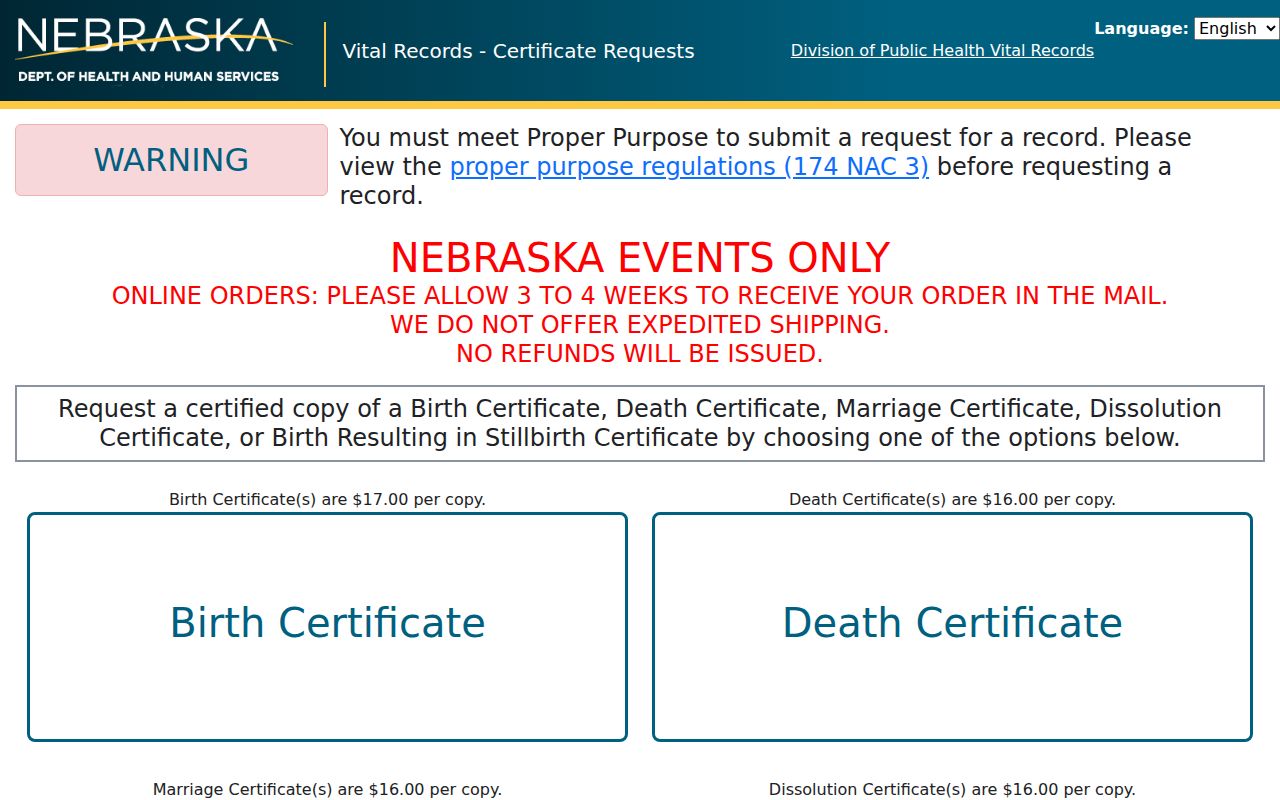
Genealogical release follows 174 NAC 3-004.06 when the requester documents that the registrant has been deceased at least 50 years. Section 84-712.05 also protects specified vital-event information and certificate numbers. A historical index, a genealogical copy, and a current certified certificate may therefore require different paths.
Douglas County Resident Lookup Details
A result is easier to assess when its parts are captured before a second search begins. JUSTICE describes case information that may include a summary, party names and roles, offense information in criminal matters, financial information, the register of actions, hearings, orders, judge notes, and available document images. The final display varies by case, so save what appears rather than filling missing fields from memory.
| Result detail | Why retain it |
|---|---|
| Court, county, and case number | Identifies the exact file and jurisdiction. |
| Case type, filing date, and party role | Separates similarly named people and avoids turning a party listing into a residence claim. |
| Attorney, judge, events, hearings, and orders | Preserves the docket context shown by the public record. |
| Disposition, judgment, or financial balance | Records the field as displayed, with its date, without inferring a broader conclusion. |
| Image link and retrieval date | Lets the reader identify whether the conclusion came from an index, detail screen, or underlying image. |
Parcel cards, voter records, license entries, and court dockets have different evidentiary weight. A parcel ID can join assessor, GIS, and recorder systems. A case number joins JUSTICE events and images. Neither alone proves a whole life history. Label each fact as listed at, recorded as, indexed under, or shown on, matching the source's own claim.
Douglas County Records Request Path
When an official page does not provide the needed record, direct the request to the right custodian. The assessor handles valuation and parcel administration, the Register of Deeds holds recorded instruments, court staff and JUSTICE handle cases, DHHS handles certificates, and the Election Commission handles voter-register access. The offices may be near one another in Omaha, but their records are not interchangeable.
Nebraska's Public Records Act, Neb. Rev. Stat. §§84-712 to 84-712.09, allows examination during normal office hours and sets rules for existing records, copying cost, estimates, deposits, and response. A written request should receive a response, estimate, or denial explanation within four business days. The law does not require a custodian to create a new list or format.
Name the custodian, record series, name or address, date range, case number or legal description when known, desired format, and request for segregable nonexempt portions. Ask for a fee estimate, any required deposit, the response date, cited exemption, and review path. That narrow request is more useful than asking a county office to assemble a general profile.
Note: Preserve a custodian's stated exemption and the response date so a later request does not confuse unavailable, confidential, and unsearched records.
Douglas County Resident Lookup Limits
Nebraska's public-records law has exceptions for confidential information, protected personal and medical information, specified vital-event records and historical indexes, and other protected categories. Voter lists have special purpose and copying rules. DHHS health and statistical information is confidential under §71-602, and vital-record release depends on the record and requester. An official absence can reflect timing, spelling, jurisdiction, coverage, privacy, indexing, or a portal problem.
The Nebraska Address Confidentiality Program provides substitute addresses for qualifying participants. If a public record shows one, treat it as a protected-program indicator and do not infer a residential location. Protected voter categories also remain outside an ordinary lookup. Corrections belong with the office that created or holds the record, not with a copied search result.
Lawful use. Use a Douglas County resident lookup for personal, lawful research and respect every custodian's terms. Do not use record information to stalk, harass, intimidate, or harm anyone.